
The India Meteorological Department has issued a 'Red Alert' and predicted 'very heavy' to 'extremely heavy' rainfall across several districts of Assam till Thursday.

LIVE! Incessant rains: Red Alert in 5 Kerala districts

Historically, October has seen some of the worst landslide events in Darjeeling and Sikkim Himalayas.

In a statement, it said 198 properties in the state were partially damaged and 30 houses completely destroyed in the rains from July 31 to till date.

The rain and flood situation in northeastern states remained grim on Tuesday, with lakhs people affected in Assam, Mizoram and Manipur, even as the meteorological department predicted more rain in several parts of the region.

Mumbai and its adjoining areas were lashed by heavy showers on Tuesday, causing water-logging at a number of places, including railway tracks, which slowed the movement of trains and vehicles on roads.

The local train traffic on the Central and Western Railway routes was mostly normal though the trains were running a few minutes late, railway officials said.

Tourist centres have been closed in many districts, including Kottayam and Thiruvananthapuram, and a night travel ban has been imposed in the hilly areas of Idukki district.
The minimum temperatures are very likely to fall by 2-5 degrees Celsius over most parts of East India, Central India over the next two-three days, while the spell of intense cold can extend beyond that in the Northwest part of the country.

The orange alert has been issued for moderate or heavy thunderstorms and wind speed with 30-40 km per hour to reach some districts of Odisha within the next three hours.

Intense spells of rain are likely to continue in the districts of Thane, Raigad and Mumbai during next four hours, the India Meteorological Department (IMD) said.

The IMD issued a 'red alert' for Pune district and asked people to take precautions.

Delhi is likely to receive the first monsoon showers on June 30 or July 1, India Meteorological Department (IMD) officials said on Tuesday.

The IMD has issued Yellow alert for Thiruvananthapuram, Kollam, Pathanamthitta, Alappuzha, Kottayam, Ernakulam, Idukki, Thrissur, Malappuram and Kozhikode districts for today whereas Wayanad too has Yellow alert on May 22.

A deep depression over the Bay of Bengal intensified into a cyclonic storm, named Remal, on Saturday evening and is likely to turn severe before making landfall between the coasts of West Bengal and Bangladesh on Sunday midnight, the India Meteorological Department (IMD) said.

The bounteous monsoon this year has already dumped 1159.4 mm of rainfall in Delhi till Thursday afternoon, the highest since 1964 and the third-highest ever, according to the IMD data

In Uttar Pradesh, the death toll due to lightning strikes rose to 42.

A day after heavy showers battered Mumbai, the rain intensity reduced briefly on Monday morning and picked up momentum again, leading to water-logging at some places and disrupting local train services, officials said.

Lakhs of voters will have to bear the searing heat when they step out to exercise their franchise in the second phase of the Lok Sabha elections on Friday.

The city has been witnessing heavy rains since Tuesday night, resulting in water logging in many areas.

Mumbai civic body took to Twitter to inform citizens about the do's and don'ts and asked them to "stay hydrated and safe".

The India Meteorological Department said the southwest monsoon further advanced into Delhi, Uttar Pradesh, Himachal Pradesh, Jammu and Kashmiri, some parts of Punjab, Haryana and Rajasthan on June 30.

The Met office has issued a "red" warning for Delhi, Haryana, Punjab and west Rajasthan, stressing the need for "extreme care for vulnerable people".

The India Meteorological Department has issued an 'orange' alert.

According to the India Meteorological Department (IMD), the Ayanagar weather station recorded 99.2 mm rainfall, the maximum in the city, during the 24-hour period ending at 8.30 am on Thursday.

Delhi's minimum temperature on Wednesday morning plunged to 4.4 degrees Celsius -- the season's lowest -- making the national capital colder than Dharamsala, Nainital and Dehradun.

The weather department also said the national capital recorded only two rainy days this May, the lowest in 10 years.

Delhi sweltered under intense heat as the Safdarjung observatory, considered the official marker of the national capital, noted a high of 43.8 degrees Celsius, four notches above the normal average.
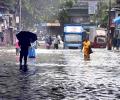
Some low-lying places like Hindmata, and areas in Dadar and Sion, including the Gandhi Market and road number 24 in Sion, were inundated, forcing pedestrians to wade through the water and making it difficult for motorists to commute.

Mumbai has been witnessing heavy rains since Wednesday.

The maximum temperature at the Safdarjung Observatory, Delhi's base station, is likely to rise to 45 degrees Celsius.

Waterlogging was reported in Andheri, Kurla, Ghatkopar, Chembur and some other places.

The mercury at the Safdarjung Observatory is expected to breach the 43-degree mark on Thursday and touch 44 degrees Celsius by Friday, according to the India meteorological department.

'Usually the average rainfall per day is around 8 mm and India is receiving 10 to 11 mm per day since the last one week.' 'July seems to be very good for the entire country.'

A blinding layer of dense fog over north India, including Delhi, caused major inconvenience to commuters. The visibility levels were 50 metres around 5:30 am.

The IMD has issued an orange alert for Mumbai, warning of very heavy rains at isolated places with strong winds on Monday as the very severe cyclonic storm Tauktae is likely to pass close to the Mumbai coast towards Gujarat.

The mercury breached the 46-degree Celsius mark in several places such as Allahabad (46.8 degrees Celsius) and Jhansi (46.2 degrees Celsius) in Uttar Pradesh; Sports Complex (46.4 degrees Celsius) in Delhi; Ganganagar (46.4 degrees Celsius) in Rajasthan; Nowgong (46.2 degrees Celsius) in Madhya Pradesh; and Maharashtra's Chandrapur (46.4 degrees Celsius).

Heavy rains over a span of few hours flooded many parts of Nagpur city, following which more than 400 people, including 70 students from a school for the speech and hearing-impaired, were rescued, said Maharashtra Deputy Chief Minister Devendra Fadnavis on Saturday.

The Santacruz weather station in the suburbs recorded 129.4 mm rain between 8:30 am and 5:30 pm on Thursday. The Colaba weather bureau in Island City reported 18.8 mm rain during the same period.

Gale-force winds, heavy rainfall and high tidal waves swept the coastal belts of Maharashtra and Goa as Cyclone Tauktae hurtled northwards towards Gujarat.
